- On July 30, we'll start with Getting the Big Picture, covering the theoretical background from cognitive science, and examples of successful behavior change campaigns that we can learn from.
- On August 13, we'll have Tools for Social Change Campaigns, in which Joe will introduce a 'designers toolkit' for social change, applying the groundwork from part 1 to practical methods for understanding and driving the process of change.
- On September 10, we'll finish with a Design Lab for Your Campaign. Each participant will create an action plan for a behavior change campaign, and we'll critique each others' so we can all learn from each other.
Jun 10, 2011
Why (and how) to focus on behavior change
Sep 23, 2010
How to talk about climate change (or any other issue, for that matter)
Sep 1, 2010
Guest Post: How To Bring About Large-Scale Behavior Change review
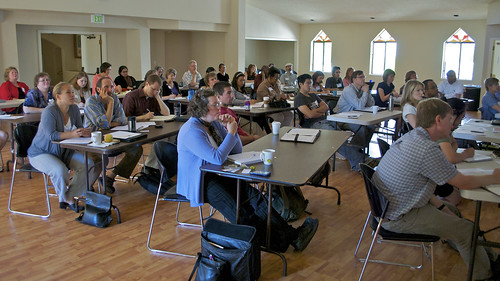
I share in the belief that a critical mass of people can envision an equitable and sustainable existence in harmony with living systems on the planet, and once we have done so, our hardest work is finished. Then we only have to build that world in the physical dimension.Joe Brewer’s class, “How to Bring About Large-Scale Behavior Change,” represented to me an important step in the process of making that happen.The class, sponsored by Sustainable Seattle and held on Wednesday, August 25th 2010 at the lovely Southside Commons, was multi-layered. Participants may have come away with an entirely different assessment of its value and substance, and I honor that. The content was rich and participation was fruitful. A variety of meaningful knowledge was shared and created throughout the day.For me the most satisfying areas were esoteric, though, and yet Joe made them accessible. These include explicit recognition of the significance of metaphor and epic narrative, and the phenomenon of gut reactions to ideas versus the false concept that reactions are based in rational reasoning.Human collective consciousness is full of shared imagery, icons, archetypes, and other forces that influence our individual and group beliefs and behaviors. We can intentionally seed this fertile territory with material that we most wish to build our world around. At least I believe this, and it seemed to me that Joe integrated this wisdom in his ideas and models.If we are mindful and carefully deliberate, the images, words, stories, and other tools we employ to generate change, we can penetrate to the core of human consciousness. This is a powerful way to work.Changes made in collective consciousness are subtle yet profound. Try this: close your eyes and imagine this planet we cherish. Recall aspects of life on Earth that you love. What do you see in your mind’s eye? What would you like to see more of? How do you feel when you do this? What if we could realize our best scenarios? Shall we aim for that? What is the role of imagination as we create our world?Artists and psychologists operate in the zone of collective consciousness, as do many who work in other fields such as cultural anthropology and education. It was refreshing and inspiring to see Joe introduce and highlight this wisdom, and exemplify it with compelling slides and activities.
I hope Joe will continue to develop these areas of his work, for I believe that metaphor, epic narrative, and gut reactions may be a vital part of the most powerful activism available to us at this time. As a movement we need to explore the role of these elements more fully. This class stimulated inquiry.As many readers know, Joe is the founder of Cognitive Policy Works and Seattle Innovators. He has studied behavioral and cognitive psychology, political science, physics and atmospheric science. Check out Joe’s writings if you haven’t already done so.
Aug 23, 2010
5 Things You’ll Need to Know to Change Human Behavior
As I prepare for the workshop next week on How to Bring About Large-Scale Behavior Change, it occurs to me that people might want to know why I believe it is finally possible to intentionally design campaigns that result in significant behavioral change.
Here are five things I’ve discovered that lead me to the conclusion that change processes can be designed and implemented effectively:
#1: We now know we were wrong about human nature.
Throughout most of the 20th Century, research into the foundations of human nature was dominated by a series of what philosopher of science Thomas Kuhn called “scientific revolutions”. Every decade or so a new theory would arise that pulled the foundations out from under the one that came before it. In the early 20th Century, focus was on behaviorism with the assumption that it wasn’t possible to measure aspects of subjective experience. This was challenged by the work of Sigmund Freud when he demonstrated that influences from subconscious experience could be measured (and were quite significant). Later came the “cognitivist” period dominated by formal arguments about the “abstract logic” of human thought. This was challenged by studies into the emotional influences of intention and belief for altering behavior.
The dominant theory that persisted throughout this entire period has been the Theory of Rational Action that claims human beings are abstract symbol manipulators (much like a calculator or computing machine) that seek to maximize their self-interest. This theory laid the foundation for most of the major institutions of society today, from stock markets to government agencies.
And we know that this theory of human nature is wrong. The first step to bringing about large-scale behavior change is finding the errors in our ways from past efforts that didn’t work.
#2: We now know how REAL human nature works (mostly).
While many puzzle pieces are still missing, scientists have pieced together enough of the picture to know that human beings are embodied creatures. This means we work the way we do because of the kinds of brains we have, the kinds of bodies we have, and the typical experiences that pervade our evolutionary history.
The basic picture is that human nature is:
- Profoundly moral: Our behavior is shaped by value judgments, deeply held beliefs, and assertions about right and wrong;
- Profoundly social: We are influenced by the behavior of those around us through shared stories, common expectations, and the need for cooperation (and competition);
- Deeply emotional: Contrary to past assumptions, we reason with our emotions. Just imagine trying to ask someone out on a date without those important emotional cues about alertness, enthusiasm, and appeal;
- Rational in context: Decisions are made via context-based logic determined by how we understand the situations we find ourselves in;
- Informed by the interplay of body, brain, and environment: All of these factors arise at the junction of bodily experience in the world where we interpret, plan, and act.
#3: It all comes down to good design.
Attempts to change human behavior will depend on knowledge like this. We have to design new modes of interaction (such as social media platforms like facebook and MySpace), better structures in the built environment (to change the patterns of experience), and more human-oriented organizational forms (that take REAL human nature into account).
With positive knowledge both about where we went wrong in the past and what we now know that is right, we can engage in system design to promote socially desirable outcomes like reductions in environmental impacts and greater sensitivities to the needs of others.
#4: This includes how motivation works.
One of the most important areas to consider good design is in the incentive structures that drive much of human behavior. The assumption that humans are self-interest maximizers has lead to many pay-for-work models that reward selfishness and greed in order to rise up the ladder. This theory has been deeply critiqued and challenged by studies into human creativity, such as that of Daniel Pink.
The key to behavioral change is understanding how motivation works in different environments. Then one needs to observe how people are using the environments they find themselves in now. The combination of these two knowledge sources will provide insights into how new environments should be designed.
#5: It’s been done before (many times).
History is filled with examples of change-makers successfully driving large-scale behavioral change. Guided by contemporary insights we can dissect past success stories and cultivate systematic methods for designed change. A few case studies that might be particularly enlightening are:
- The first televised Presidential debate and its impact on voting behavior;
- Inspirational social movements like the Civil Rights Movement or events that led to the creation of the Endangered Species Act;
- Transformational events like the terrorist attacks of September 11th and the bombing of Pearl Harbor;
- The rise of public relations and modern advertising.
This small sampling, if properly analyzed, can be exceedingly insightful. I will share some preliminary results of my analysis for these and other related topics in the workshop next week.
So, in conclusion, I believe it is finally possible to design campaigns for changing large-scale human behavior because of the solid foundations we now have from the cognitive and behavioral sciences. I will share more of the practical implications of this knowledge on August 25th in Seattle — and continue developing the tools necessary to put it to work for NGOs, government agencies, and social businesses in the days ahead.