What if you could feed wallabies in downtown Seattle?
Have you noticed how many lots have been left empty or partially developed due to the stalled economy? These vacant project sites are all around us. Unattractive and unbecoming of our city, we pass by them every day: empty holes, barren plains of gravel, voids in the city fabric. How can we convert these eyesores to opportunities?
The Seattle Design Commission wants your ideas for Holding Patterns, interim uses for stalled project sites. We are seeking your concepts to transform the following types of stalled project sites around the city:
holes in the ground surface lots ongoing construction above or below street level
Whether a concert space or a bumper car track, basketball hoops or a fleeting performance stage, from temporary to semi-permanent, wacky, practical or both, the Design Commission is welcoming any and all ideas. Artists, designers, non-profits, businesses, developers, students, astronauts, everyone is invited to contribute ideas. Interdisciplinary teams are encouraged.
Deadline: Monday, May 24th, 2010 Your submission should include the following:
a brief narrative including rationale, goal, purpose, program, and design intent the location, if specific (all city-wide locations are acceptable) a site plan and/or images that communicate your ideas Maximum of four 8.5” x 11” single-sided pages per site category
There will be a follow up implementation workshop for selected ideas, so please be prepared to make a two minute pitch for potential partners who are able to help make your ideas a reality.
Submit via e-mail to Valerie.Kinast@seattle.gov a pdf formatted file and in the body of the email the names/backgrounds of participants and contact information for one person. Please put “Holding Patterns” in the subject line. 6 MB maximum file size.

Showing posts with label Design. Show all posts
Showing posts with label Design. Show all posts
Apr 23, 2010
Holding Patterns - interim uses for stalled project sites
Seattle's Design Commission is looking for creative ideas to turn empty lots into something good while they wait for development to restart. Here's their press release:
Personally, I love this idea, because it sounds like the city is opening up the possibility of quite diverse, off-the-wall land uses, and I find a lot of what's been built in the last couple of years a bit bland and overregulated.
Professionally, this fits several of Sustainable Seattle's priorities, because it makes land use more efficient, adds a very open piece to the city planning process, lets the community say more about land use, and has the potential to make some currently blighted parts of the streetscape much more attractive. And of course, any entry to this competition would be good source material to start an entry to our Dream a Sound Future competition from.


Mar 10, 2010
The importance of imagery
I am very much a verbal thinker—I understand a problem by reading, talking or writing about it—but I'm becoming increasingly persuaded of the value of clear, appealing images. They can be a very powerful supplement or even replacement for a mass of words, and serve many purposes:
Emotional engagement
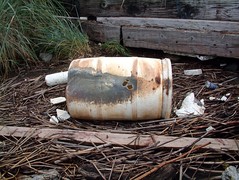
I know I'm not the only one who has put energy into a sustainability issue, become emotionally involved, and then had trouble explaining to other people why I cared so much. For example, I was a Sound Steward for a couple of years, which involved adopting one of People for Puget Sound's habitat restoration sites, and making repeated visits to monitor and maintain the site. It's a brilliant program, both because channels volunteer labour to an important project and because close involvement with a specific site encourages the stewards to get emotionally involved. I became a sworn enemy of blackberry brambles, but had a hard time explaining to people just how much of the damage to this site was caused by human carelessness. Listing the astonishing array of trash that washed up was mindnumbing, so it was much easier to just show people:


Showing contrasts over time
A lot of the ideas we try to explain about sustainability are about contrasts over time: what we have today compared to what we've lost, or what we could have if we were collectively smarter. The scale of these changes over just a few generations can be very hard to grasp, so images can be a very powerful tool. One of my all-time favourites is Sightline's astonishing map of how far humans have shrunk the grey wolf's habitat:
Demonstrating scale
Another challenge as a sustainability advocate can be conveying the collective impact of 6 billion people. So many of the behaviours we ask people to change are meaningless on their own, but become powerful when enough peoples' actions add up. The trouble is, once we start listing huge numbers, they become difficult for anyone to grasp what they mean, so help is needed. Local artist Chris Jordan has a very powerful approach to this: Running The Numbers.
Relative numbers can also be hard to put into context, and a good image can go a long way. For example, groups with a financial interest in obstructing meaningful climate change action like to talk about the thousands of scientists who have signed their petition. It sounds very impressive without its context, but a single image can clearly show what a drop in the ocean those signatures really are:

Image credit: InformationIsBeautiful.net - see their original post for details and a larger version.
Extracting wisdom from data
Finally, the process of making the right image can help us to understand what's really going on behind a mess of statistics. One of the classic examples of this was by a British doctor, John Snow, who seems to have been the first person to prove that unsanitary water spreads cholera. In the midst of an outbreak, he plotted the sites of all the cases on a map, and from that map came the insight that these incidents were all linked; an insight that was crucial to ending that outbreak and learning to control cholera ever since. For more on this story, I strongly recommend Steven Johnson's website, videos and book: The Ghost map.
Come and learn more with us
All of these are reasons why I'm excited about a new seminar we have just launched: Visualization Tools for Sustainability. The first session will be in the afternoon of May 4th, at the downtown Seattle Library, and you'll be able to learn more about making and using visualizations to tell stories about sustainability.
Emotional engagement
I know I'm not the only one who has put energy into a sustainability issue, become emotionally involved, and then had trouble explaining to other people why I cared so much. For example, I was a Sound Steward for a couple of years, which involved adopting one of People for Puget Sound's habitat restoration sites, and making repeated visits to monitor and maintain the site. It's a brilliant program, both because channels volunteer labour to an important project and because close involvement with a specific site encourages the stewards to get emotionally involved. I became a sworn enemy of blackberry brambles, but had a hard time explaining to people just how much of the damage to this site was caused by human carelessness. Listing the astonishing array of trash that washed up was mindnumbing, so it was much easier to just show people:
Showing contrasts over time
A lot of the ideas we try to explain about sustainability are about contrasts over time: what we have today compared to what we've lost, or what we could have if we were collectively smarter. The scale of these changes over just a few generations can be very hard to grasp, so images can be a very powerful tool. One of my all-time favourites is Sightline's astonishing map of how far humans have shrunk the grey wolf's habitat:
Demonstrating scale
Another challenge as a sustainability advocate can be conveying the collective impact of 6 billion people. So many of the behaviours we ask people to change are meaningless on their own, but become powerful when enough peoples' actions add up. The trouble is, once we start listing huge numbers, they become difficult for anyone to grasp what they mean, so help is needed. Local artist Chris Jordan has a very powerful approach to this: Running The Numbers.
Relative numbers can also be hard to put into context, and a good image can go a long way. For example, groups with a financial interest in obstructing meaningful climate change action like to talk about the thousands of scientists who have signed their petition. It sounds very impressive without its context, but a single image can clearly show what a drop in the ocean those signatures really are:
Image credit: InformationIsBeautiful.net - see their original post for details and a larger version.
Extracting wisdom from data
Finally, the process of making the right image can help us to understand what's really going on behind a mess of statistics. One of the classic examples of this was by a British doctor, John Snow, who seems to have been the first person to prove that unsanitary water spreads cholera. In the midst of an outbreak, he plotted the sites of all the cases on a map, and from that map came the insight that these incidents were all linked; an insight that was crucial to ending that outbreak and learning to control cholera ever since. For more on this story, I strongly recommend Steven Johnson's website, videos and book: The Ghost map.
Come and learn more with us
All of these are reasons why I'm excited about a new seminar we have just launched: Visualization Tools for Sustainability. The first session will be in the afternoon of May 4th, at the downtown Seattle Library, and you'll be able to learn more about making and using visualizations to tell stories about sustainability.
Jun 13, 2009
Everett teen redesigns the water bottle

Everett, WA high school senior Jordan Steeves has reimagined the ubiquitous water bottle to help market a paper water carton, Cykle. Cykle uses renewable resources, reduces waste, and biodegrades much sooner than conventional water bottles. Along the way, Steeves has inspired many students and scholars and was winner of the Washington State University's annual high school energy competition, Imagine Tomorrow. Steeves is now off to Western Washington University to major in environmental sciences...with young minds like Steeves' at work, we're in for a bright green future for sure. Congrats Jordan!
Find an article and video on Steeves' project on King5.com.
Learn about other paper carton solutions like h20 and Tetra Pak.
Subscribe to:
Posts (Atom)