Showing posts with label Training. Show all posts

Apr 14, 2011

"Race: The Power of an Illusion" Board Training

This last weekend Sustainable Seattle's board had a training about race, ethnicity and the challenges and opportunities these discussions can bring about. The all day training on a warm Saturday afternoon started off light and high minded, but as we continued to go through the training videos and the discussions the mood began to become more murky.

The ideas of race are of course a socially created construct. Race does not exist biologically at all, but the point of this training is to confront the socially created idea of race and how it can complicate relationships. The trainings are a combination of videos put on by PBS and discussions that are facilitated to ensure genuine honesty, respect and openness.

The discussions were lively, touchy, and powerful. Ideas were debated, ratified and thrown out and the entire day was an example of how much deep seated almost subconscious ideas about race are within us all. This social construct has been a part of our society for hundreds of years and that amount of unconscious programing takes time, courage, and love to overcome.

One of the most important lessons we learned as a board was that we all have room to grow and to open our hearts to compassion. We view social justice as one of our three main themes and the fact that we have put so much effort into learning more about ourselves and each other is a testament to our dedication. It was not an easy discussion or training, but it was an important first step in getting us on the same wavelength. We are currently discussing cultural competency training as our next step to build on the lessons we've learned.

Jan 31, 2011

Sustainable Communities Workshop

Sustainable Communities Start with Healthy and Green Homes Workshop


Workshop Overview: EPA and the Puget Sound Chapter of the Pacific Northwest International Section (PNWIS) of the Air & Waste Management Association are presenting this two-day workshop on the connections between the homes and communities where we live and the impact they have on our health. Guest speakers and attendees from health, housing, green building, and sustainability will come together to share what has worked and what the future looks like. Better housing results in better health.

When: February 2-3, 2011

Where: Seattle, Washington, at the downtown Red Lion Hotel (scroll down to Red Lion on 5th Avenue to reserve lodgings) (map)

How to register: Register by January 14, 2011 to get the early registration rate of $200. After January 14 the fee is $250. Note: PNWIS will collect registration fees to cover its share of the costs for this meeting. EPA does not receive any part of the fees.
Register now

Agenda: Draft agenda for Sustainable Communities Start with Healthy and Green Homes (PDF) (2 pp. 94K)

Speakers: Speakers and Presentation Summaries (PDF) (16 pp. 164K)

Who should attend: Builders, architects, planners, sanitarians, building inspectors, facilities managers, tribal housing authorities, health care professionals, community outreach workers, state/local governments and NGOs. Opportunities to earn Continuing Education Units (CEUs) will be available.

Workshop Track Descriptions:

  • Indoor Air Quality and Health -Health- People spend over 90% of their time indoors, and indoor air pollution can reach 100 times the concentration as outdoor air. Where you live, work, and go to school can have an impact on your health. Come and learn how you can identify indoor air pollution sources and ways to mitigate and improve your indoor air.
  • Homes, Indoor airPLUS and Energy Star - Come and learn all the new and exciting improvement and upgrades for existing homes, new energy saving features for new homes (ENERGY STAR and Home Star), and options to improve healthy indoor living (Indoor airPLUS). ENERGY STAR, and Home Star
  • Green Buildings - How can we improve our current buildings to make them more energy efficient? Come and learn more about LEED and Built Green programs and other technologies you could do to make you building healthier, more energy efficient and marketable.
  • Sustainable Communities - Come and learn from city planners and urban developers on sustainable community designs. Concepts to improve a community's accessibility.
For more information: Contact Susan Titus (titus.susan@epa.gov) at 206-553-1189.

Jan 18, 2011

Training courses from Sustainable Seattle in January.

Building better relationships
One of the keys to happiness is building good relationships with the people we work with, live with and see every day. We started developing classes about this last year, even before adopting Gross National Happiness as our new indicator framework, and now it's become even more relevant. We're pleased to announce two classes at the end of this month about different aspects of improving interpersonal relationships:

On January 24th, we'll be holding a morning workshop for non-profit staff about Getting along with your Board of Directors. Laura Pierce, an organizational consultant with two decades' experience helping nonprofits grow, will teach you how to create a productive and mutually supportive working relationship between nonprofit staff and board members. You will learn:Typical roles and responsibilities of nonprofit boards
  • How board/staff division of duties varies depending on the life stage of the nonprofit organization
  • How to build a strong Board/Executive partnership
  • Tools to ensure alignment and accountability
  • Common pitfalls to avoid

You will walk away with an enhanced understanding of how boards add value and engagement strategies to try next week in your boardroom.

To read more and register online, visit
http://sustainableseattle.org/training/217


On January 31st, we'll have an afternoon workshop about Conflict management & resolution. John Abel and Paul Kramer, two consultants who were a fantastic resource for us during last year's growth spurt, will teach you how to understand conflict from the inside out and turn interpersonal conflicts from sources of frustration into a force for positive change.

Come prepared with a story of conflict from your own experience to share and learn from, and experience the satisfaction of expressing your views & feelings in ways that do not invite defensiveness.
To read more and register online, visit
http://sustainableseattle.org/training/218


Don't forget our other workshops

More to be announced soon for February and March, including Rain Garden design & construction, Advanced Change Agentry Skills and Urban Stream Restoration
see http://sustainableseattle.org/training for details.


Other events in the community

The Economics of Happiness film screening & discussion at Town Hall, 1119 8th Ave, tonight
Leaping Frog Films to be Shown at Feathered Friends, 119 Yale Ave N, Jan 21st

Solar 101 workshop at the Queen Anne branch library, 400 W Garfield St, Jan 29th

Mar 10, 2010

The importance of imagery

I am very much a verbal thinker—I understand a problem by reading, talking or writing about it—but I'm becoming increasingly persuaded of the value of clear, appealing images. They can be a very powerful supplement or even replacement for a mass of words, and serve many purposes:

Emotional engagement
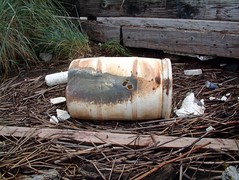
I know I'm not the only one who has put energy into a sustainability issue, become emotionally involved, and then had trouble explaining to other people why I cared so much. For example, I was a Sound Steward for a couple of years, which involved adopting one of People for Puget Sound's habitat restoration sites, and making repeated visits to monitor and maintain the site. It's a brilliant program, both because channels volunteer labour to an important project and because close involvement with a specific site encourages the stewards to get emotionally involved. I became a sworn enemy of blackberry brambles, but had a hard time explaining to people just how much of the damage to this site was caused by human carelessness. Listing the astonishing array of trash that washed up was mindnumbing, so it was much easier to just show people:

I think this one went out of bounds


Showing contrasts over time
A lot of the ideas we try to explain about sustainability are about contrasts over time: what we have today compared to what we've lost, or what we could have if we were collectively smarter. The scale of these changes over just a few generations can be very hard to grasp, so images can be a very powerful tool. One of my all-time favourites is Sightline's astonishing map of how far humans have shrunk the grey wolf's habitat:


Image credit: Sightline Institute, from a collection made for the Cascadia Scorecard


Demonstrating scale
Another challenge as a sustainability advocate can be conveying the collective impact of 6 billion people. So many of the behaviours we ask people to change are meaningless on their own, but become powerful when enough peoples' actions add up. The trouble is, once we start listing huge numbers, they become difficult for anyone to grasp what they mean, so help is needed. Local artist Chris Jordan has a very powerful approach to this: Running The Numbers.

Relative numbers can also be hard to put into context, and a good image can go a long way. For example, groups with a financial interest in obstructing meaningful climate change action like to talk about the thousands of scientists who have signed their petition. It sounds very impressive without its context, but a single image can clearly show what a drop in the ocean those signatures really are:


Image credit: InformationIsBeautiful.net - see their original post for details and a larger version.


Extracting wisdom from data
Finally, the process of making the right image can help us to understand what's really going on behind a mess of statistics. One of the classic examples of this was by a British doctor, John Snow, who seems to have been the first person to prove that unsanitary water spreads cholera. In the midst of an outbreak, he plotted the sites of all the cases on a map, and from that map came the insight that these incidents were all linked; an insight that was crucial to ending that outbreak and learning to control cholera ever since. For more on this story, I strongly recommend Steven Johnson's website, videos and book: The Ghost map.

Come and learn more with us
All of these are reasons why I'm excited about a new seminar we have just launched: Visualization Tools for Sustainability. The first session will be in the afternoon of May 4th, at the downtown Seattle Library, and you'll be able to learn more about making and using visualizations to tell stories about sustainability.

Jul 28, 2009

Who's Who | EOS Alliance

Green jobs are becoming more abundant, and working people such as myself would love to have them. The problem is that most of us have the wrong kind of experience or education to actually get hired. The Environmental Outreach and Stewardship Alliance (EOS Alliance), founded by Erick McWayne, solves this problem by providing the technical training for everything environmental, from chemical contamination cleanup to policy issues to home weatherization. Their environmental training course calendar can be found here.

If you're not interested in advanced technical training, EOS hosts many programs for the average citizen, like how to raise chickens in your backyard. The public events calendar is here.

Meanwhile, The EOS Alliance is doing green work now. They provide residential energy audits and weatherization (see the Green Blocks Pilot Project), and organize volunteer work parties to restore the local ecology by replacing invasive species with native ones. Go here to find out more about volunteering.


Entry by Alyssa Ballinger Johnson

Apr 2, 2009

Workshop | EOS | April 29th


EOS Alliance presents: Strategies for Sustainability: Best Practices - Understanding and customizing leading sustainability strategies and frameworks.

Date | April 29, 2009
Time | 9 A.M. to 5:00 P.M.
Location | NWETC - Headquarters, 650 S Orcas St, Suite 220, 98108


>> More info