Picking a non-profit to donate to is tough, there are so many great organizations out there! There are national groups, local, large, small...when you've finally narrowed it down to the group (or groups) that match your own values you feel happy to have made an impact. But your giving heart always wants to give more--if only you could save the world!
Well, you're in luck. This Wednesday, May 15th, your charitable donation to a single charity, like Sustainable Seattle, will give in a bigger way. How? Gifting on May 15th during GiveBIG, The Seattle Foundation's one-day online giving event will help over 1,400 Seattle area non-profits!

Showing posts with label funding. Show all posts
Showing posts with label funding. Show all posts


Jun 10, 2011
Why (and how) to focus on behavior change
Last year, we hosted a workshop called How To Bring About Large-Scale Behavior Change, taught by Joe Brewer. It was our best-attended workshop of the year, and people loved it and seemed to leave it buzzing with ideas, so we're running it again, only this time we're going further.
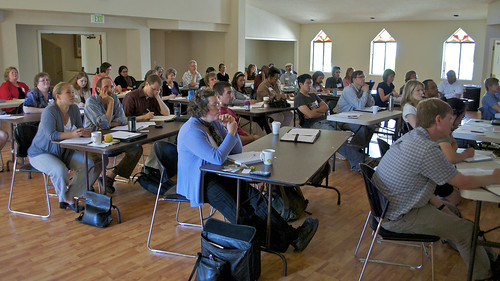
The one complaint that many participants had last year was that in a one-day workshop (realistically 6½ hours after breaks are accounted for) with a lot of material to cover, there wasn't enough time for hands-on practice. This time round, we're breaking it into 3 half-day sessions, with a couple of weeks between each so people can mull over the material, and the final one will be devoted to practice and feedback:
- On July 30, we'll start with Getting the Big Picture, covering the theoretical background from cognitive science, and examples of successful behavior change campaigns that we can learn from.
- On August 13, we'll have Tools for Social Change Campaigns, in which Joe will introduce a 'designers toolkit' for social change, applying the groundwork from part 1 to practical methods for understanding and driving the process of change.
- On September 10, we'll finish with a Design Lab for Your Campaign. Each participant will create an action plan for a behavior change campaign, and we'll critique each others' so we can all learn from each other.
I'm really excited about this class, but we also recognise that a lot of people who are interested won't be able to make it to three separate sessions spread out in time like that. If you're one of those people, we have an alternative for you: we're raising money to write a Designer's Manual for Large-Scale Change which will be free to download and stand alone as an introduction to the same ideas. Here's short video of Joe introducing the project:
We would of course very much appreciate your contribution; if you'd like to donate or read more, head over to:
As with many of the classes we put on, I am sometimes asked why Sustainable Seattle is interested in promoting this particular topic. The environmentalist angle on this is that I firmly believe that we already have all the technology we need to deal with the environmental crises looming over us, and what we really need to do is persuade people to make the right choices. Lately we've been talking about happiness, and the links to that are are actually quite similar. Whether we look at individuals' happiness, or the ways that each of our behavior affects everybody else's happiness, we find ourselves presented with a quite well developed body of knowledge about things we could be doing to make the world, and yet most people aren't doing them. Many of these things are well-known and very easy, so clearly we need to get better at persuading people.
Whether your interest is in persuading people to give up smoking, drive less, get to know their neighbors or lobby politicians, you'll need to use the same insights about psychology and culture, and the same techniques based on those insights. Why don't you join us this summer to learn how?
Jul 13, 2010
Notes from Seattle Foundation Town Hall meeting – the rich get richer even in the nonprofit sector
Sustainable Seattle followed a face book invitation to The Seattle Foundation’s (SF) town hall meeting tonight. The foundation’s goals include doubling the amount given two fold by 2013, to expand the audience, and to share their knowledge. SF funds organizations, not projects. If you missed the meeting tonight, there are 3 workshops coming up- just check The Seattle Foundation website. But if you are small, new and have diverse funding- well the news is not so good.
Here are some of the changes: the grant making program changes include: reviewing applications by element with annual guidelines for each element; there are now staff element (one staff member for each of the 7 elements of the community framework- check the new website for who) with element committees (filled first by donors), no more 2 year eligibility rule, the review timeline is now longer, and the way SF works with donors and the types of grant- collaborative work, work that supports sectors.
What is not changing: the Healthy Community Framework created in 2006, addressing disparities, and guidance by the 7 elements and 3 strategies within each element.
Low priority grants include capital campaigns, emerging organizations (looking to tapping into what is already happening), small organizations with diverse revenue streams.
Really? This seems pretty outrageous that an organization with the objective of Healthy Communities will favor large single-source nonprofits. Are they looking to create the Coke and Pepsi of non-profits? Is this really healthy? Is this really funding for creating and sustaining community?
Subscribe to:
Posts (Atom)